 By Mo Abdi
 By Elias Bovard
 By Cara-Lynn Branch
 By Bita Habibi
© 2020-2025. UniversalCinema Mag.


April, directed by Dea Kulumbegashvili from Georgia, shares an astonishingly realistic image with its audience; a compact, raw, harsh, and gripping film about abortion that extraordinarily penetrates the feminine world of its protagonist, who finds herself at odds with the masculine morals and beliefs of the world around her. With an observant camera that does not interfere in the events nor tries to dramatize the scenes, it features an apparently raw yet calculated and unforgettable scene of abortion that will remain in the viewer’s memory forever.
In an exclusive interview with Mo Abdi, Dea Kulumbegashvili discusses the making and nuances of the film,
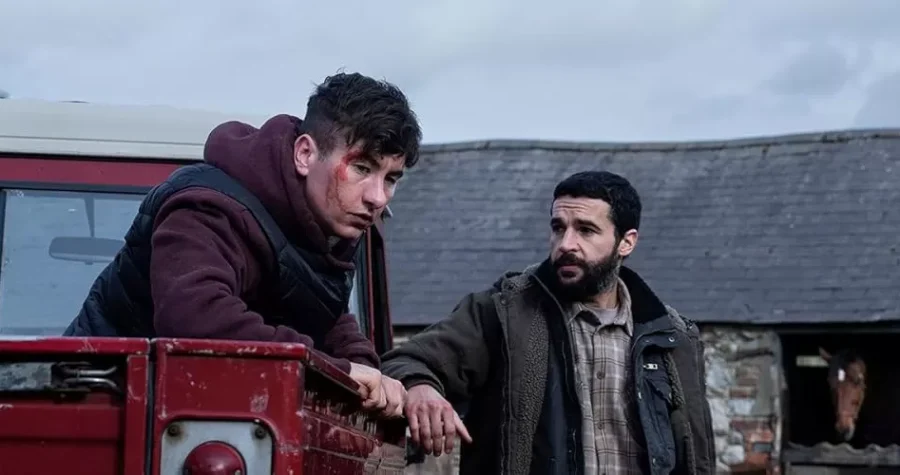
When you’re committing an act of vengeance, you really hope that final triumph will be the cherry on top to set everything right. But if movies and TV are to be believed, vengeance often leaves you feeling empty or just cycles endlessly. Released in theatres February 7th, and now available on the Mubi streaming platform, Bring Them Down tells the story of two neighbouring Irish sheep farmer families and the bitter violence they bring down upon themselves. All colours of vengeance show up in the film: the satisfying, the immediate, the rudimentary, the self-inflicted, the laboured, and so on.
In his debut feature, director Christopher Andrews captures lush scenery that moves from the expansive to the claustrophobic. People with tons of space get uncomfortably close to each other. Close enough to give a jar of piss or a slap to a loved one. He shoots scenes of convincing violence cleanly and crisply. One sequence with a shotgun is particularly memorable.
Barry Keoghan brings his trademark boyish menace as the son of one of the feuding families. In his first scene, he uses the mannerisms of a fidgety child for some beautiful subtle hostility. This same energy returns later to soften an altercation with his own father, almost like Harpo Marx looking at you silly after cutting off your necktie with large scissors.
Keoghan’s slightly comedic choices and the aforementioned jar of piss bring some levity to a fairly dour hour and a half. The drum and bassy score works wonderfully to transform the emotion throughout, creating lively tension in a land one of the families has worked for 500 years. At one point, Keoghan’s father refers to Colm Meaney’s character as a “turnip faced cunt” and gets a cheerful “nice one, uncle” for his efforts. A nice reminder that revenge can be a little fun sometimes too.
Christopher Abbott plays the son in the other feuding family, although he’s a generation older than Keoghan’s character. He performs his role with focused sadness, all his expressions observed through the prism of a traumatic opening scene flashback.
Abbott is great in this and the following is obviously no fault of his. 10 years ago, a woman cheated on me in devastating fashion. Christopher Abbott looks like the guy she did it with. He also looks like, even moreso, her brother. Have you ever been distracted watching a movie because one of the actors looks like someone who wronged you? Comment down below which actor and which person who wronged you.
The acts of violence and retribution pile up until a perspective shift halfway through resets the story to the beginning. It felt like either the movie or the viewer’s own personal desire to see revenge enacted lost steam here. But this works in a way to support the film’s more overt examination of vengeance. The flame goes out and reignites.
The perspective shift gives us the chance for an ultimately futile empathy. And shows us that Abbott and Keoghan share the pain of losing someone and maybe the jealousy of their escape. There’s a self-desentization process going on throughout. Everything builds to some truly gruesome stuff midway through, to the point that the gruesome crescendo doesn’t feel all that bad. It also builds to the point where everybody is slapping everybody around in an all out slapfest.
As a commentary on the zig zagging emotional peaks and troughs of vengeance it works well and the movie is entertaining and gripping throughout. The finale is not very satisfying though, feeling a bit dragged out. But if that’s the true reflection of how revenge makes you feel in the end, what’s there to complain about?
© 2020-2025. UniversalCinema Mag.

Every so often, a film will be released that is essentially a collection of short films. In film school, we only watched Martin Scorcese’s “Life Lessons” from New York Stories. Sometimes, these anthology projects will have a little story overlap, a character or thread that connects them. While not a short film anthology collection, Krzysztof Kieślowski’s Three Colours trilogy notably does this with minor background characters/action in Blue and White, but in Red, you see the convergence of the characters from all the films. However, the films can still be watched independently without missing context. Freaky Tales weaves a little closer with its interlocking stories, and while the first three stories can be enjoyed individually, the fourth builds on the knowledge of the previous tales.
All the Freaky Tales are interwoven, and you get this sense as soon as you tap into the second track of the mix tape, and the entry point is the same place as the first, only from a new character’s perspective. It is very pulpy and has the style of the late 80s and early 90s TV (think Tales of From the Crypt, Are You Afraid of the Dark?, and Goosebumps) fitting of its 1987 setting in Oakland, California. The first short centers on a bunch of punks who are targeted by some neo-Nazi skinheads and are going to fight back. It’s a simple punching Nazis story with budding romance at its heart (between two of the punks, not across enemy lines), the second short involves two female rappers (Barbie played by Dominique Thorne, and Entice played by Normani) who get offered the chance to rap battle Too $hort (played by DeMario Symba Driver but, the real Too $hort is a producer on the film which derives its name from his album, he also narrates), and after overcoming a little imposture syndrome and introducing a concept that comes up later, they tear it up on the stage. These first two tales end well for our protagonists. They don’t suffer significant losses and they get their desires. When we enter the third track, most audience members will be keenly aware they already caught a glimpse of this protagonist in the first track, as he’s played by Pedro Pascal. Pascal plays Clint, an enforcer for a boss, who is revealed to be the sleazy cop (played by Ben Mendelsohn) who harassed Barbie, but he’s supposed to be out on his last job. And then someone from his past comes back and, while threatening him, accidentally kills his pregnant wife. With nothing to lose, Clint wants out. But his daughter survives by a miracle, Mendelsohn’s character tries to use it against him, but Clint holds strong as we go into the final track, which is the wildest track of all.
The final track centers on the main character in Oakland’s history on the night in question when the film’s main events happen, May 10, 1987. On this night, Eric “Sleepy” Floyd set an NBA record by scoring 29 points in one quarter and 51 points in the game to help the Warriors take Game 4 in the playoff series against the Showtime Lakers. But while he is winning the game, his house and many of his teammates’ houses are being robbed. While Floyd was a hero to Oakland that day, the rest of the track is pure fiction. His house was not robbed, and so no one in his family was hurt as a result. So, while Floyd was a hero in Oakland for what he did on the court that night, he was not the sword-wielding, justice-dispensing badass that wraps up the tales. But links like Sleepy Floyd and Too $hort are the things that that ground this film in Oakland and give it a distinct sense of time and place despite the supernatural or fantastical elements.
In his limited screen time, Tom Hanks makes a memorable impression as the video store guy trying to recommend the top five underdog movies of all time to Clint. Though, in classic cinema style, he only teases Clint and the audience with number one, the filmmakers (writers and directors Ryan Fleck & Anna Boden) leave it up to audiences to do the leg work to get the answer.
Freaky Tales is in cinemas now.

Police brutality is a pervasive evil with a long history. But in Deva (new to Netflix as of March 28th), this evil is deployed to set up several genuinely funny moments and one very fun dance number. The film never tries too hard to give its anti-hero protagonist any redeeming qualities. Despite the boozing, cuckolding, and beating up of a grieving family right outside the funeral of their loved one, lead actor Shahid Kapoor manages to make the character of insanely corrupt cop Dev somewhat likeable. Kind of like a Tom Cruise swagger with more grimacing instead of smiling all the time, a more chipper Dirty Harry.
In his Hindi language debut, director Rosshan Andrrews remakes his own Malayalam film about an amnesiac cop from 2013, although with a major change to a central plotpoint. This change removes some of the natural understanding we’d have for our main character’s desperate acts. It’s almost refreshing to not offer anything to explain away his terrible actions, we just have to accept that this guy sucks. And the film as a whole doesn’t seem concerned with making a moral point anyway. It shows us these cops exist, we know they’re as bad or worse then the criminals they’re supposed to bring to justice, but now let’s have some fun. Some of the plot twists might not be the most shocking, but the way the story dodges redemption keeps you on your toes.
The on location action scenes in Mumbai look great and feel alive although one pivotal scene looks like it has some flimsy CGI greenscreen business going on. This unignorably fake scene disrupts you at the beginning right after a well crafted opening credits montage of a degrading city and its surveillance infrastructure. This odd looking scene is so out of place that I thought maybe it was added to the movie ten minutes before they uploaded it to Netflix. Which can’t be possible because it had a prior theatrical release. Speaking of Netflix, the most dramatic part of the movie cut immediately to a commercial for windshield repair, but that’s my fault for not getting the premium version of the streaming service.
The one big musical number features Kapoor’s elastic dance moves choreographed by Bosco-Ceasar. He gets into his dance by waving his gun around wildly in a crowd, not following any safety protocol. The criminals he regularly terrorizes look on. They get to dance too in a sweet moment where they think he’s dead. Kapoor brings so much power-mad, coked-up energy to his performance here, giving us everything we need to know about his character in such an efficient and entertaining way.
In his unceasing brutality, Dev does something so heinous that I was unsure the movie could recover from it. For me it created some unexpectedly dark comedy later on though. With no memory of the incident due to his near complete amnesia, Dev has to fake his way through the disciplinary hearing. He stands face to face with his victim who he cannot remember. Together they watch a video of his crime. It pauses on an image of Dev turned to the camera with his gun in the person’s mouth. Faced with his own actions, you’d expect him to become a better person. Instead it just reminds him soon after that he can deal with his problems by beating people up, much to the chagrin of his cell phone repair guy.
The funniest part to me comes out of nowhere. In a very brief moment that could almost have been in Naked Gun, members of the police force haul in Dev’s accountant and dentist to prove that he has amnesia and should be off the case. The accountant and dentist stand their wordlessly as Dev fails to recognize them.
How long will Dev be remembered for? A mural of Amitabh Bachchan in Deewaar appears in the background a couple of times and in the movie poster. The film tries to raise Dev to similar anti-hero status with his own mural after a climactic scene where he shows he has not changed. I’m not sure if he will leave such a lasting impression, but you can’t say he wasn’t a good time.
© 2020-2025. UniversalCinema Mag.

Disney’s Snow White, the latest live-action adaptation from Walt Disney Pictures, represents an ambitious yet contentious retelling of a cherished fairy tale. Directed by Marc Webb and with a script by Erin Cressida Wilson, the film grapples with the enduring legacy of the iconic 1937 animated classic while attempting to modernise its narrative. However, instead of infusing the story with vitality, the film descends into a superficial interpretation that fails to surpass its established foundations, diluting its message with unimpressive performances.
Featuring a star-studded cast, including Rachel Zegler as Snow White, Gal Gadot as the Evil Queen, and Andrew Burnap as Jonathan, a new bandit character, the film aims to introduce fresh dynamics. With a hefty budget estimated between $240 and $270 million, Disney’s Snow White seeks to be a visually striking and narratively complex masterpiece. However, the investment in glamour does not guarantee rich storytelling; it’s clear that merely dressing an old tale in new clothes cannot mask the inherent risk of monotony.
The film opens with a meticulously crafted fantastical kingdom, designed to evoke both wonder and dread. However, while the contrasts between lush woods and cold castles suggest the classic struggle between virtue and evil, they ultimately serve as a backdrop for a narrative that struggles to engage, leaning too heavily on style without substance. The largely London-filmed venture, with additional shoots scheduled for 2024, fails to deliver a profound visual or thematic experience.
At its core, Snow White’s journey—the quest for survival and justice—remains intact, but the film’s attempts to add layers introduce surfaces rather than depth. Jonathan’s character, while intended to create a compelling narrative arc, often feels like an unnecessary addition rather than a meaningful counterpart. His evolution from friend to ally and romantic partner detracts from the gravity of Snow White’s fight against her tyrannical stepmother. Regarding all the attempts, the relationship never goes further than a teenage engagement.
Zegler’s portrayal of Snow White is a complex one; while she exhibits moments of spirit and tenacity, her overall performance fails to elevate the character beyond a stereotype of innocence. The film’s songs, crafted by Pasek and Paul, may aim to enhance her journey, yet they often feel more like obligatory musical interludes than integral components of the storyline. On the contrasting end, Gadot’s performance as the Evil Queen is disappointing, reduced to superficial expressions and gestures that lack emotional depth. The comparison to Angelina Jolie’s compelling performance as Maleficent only highlights Gadot’s shortcomings, as her portrayal seeks validation without delivering anything substantial.
The film’s emotionally charged dramatic confrontations lack resolution, resulting in scenes that feel unearned. Focusing on wit over physical confrontation leaves pivotal storylines unresolved, leaving viewers disoriented. Snow White’s supposedly moral choice to spare her stepmother appears impractical, reducing the narrative tension to a shallow call for forgiveness that fails to resonate on a deeper level.
Disney’s Snow White has faced numerous controversies, particularly regarding the casting of Zegler, a Latina actress, which sparked debates on representation and authenticity, especially in light of her criticisms of the original film. These issues, amplified on social media, reflect wider discussions on diversity and inclusion. Additionally, the reimagining of beloved characters, including the dwarfs, has received mixed reactions from audiences across the spectrum.
Financially, Disney’s Snow White has struggled to meet expectations, grossing only $144.1 million by its second weekend against its exorbitant budget. Projected losses of $115 million expose the challenges of reinterpreting classic stories in a complex media landscape, struggling to attract both traditionalists and newcomers. Nevertheless, the narrative of the film may continue beyond its box office performance. A possible streaming release on Disney+ could broaden its audience and allow for a fresh re-evaluation of its themes. The film’s visual allure and attempts to address contemporary issues suggest that its cultural relevance might shift, potentially garnering more appreciation in the future.
Disney’s Snow White aspires to weave together themes of kindness and courage with modern reflections on identity and power. Despite its artistic ambitions and unresolved controversies, Disney’s Snow White struggles to establish its footing, reminding us that the core of storytelling lies in its ability to adapt and resonate meaningfully with both old and new audiences.
© 2020-2025. UniversalCinema Mag.

Berlin’s historic Delphi Palast cinema is famous for one of the most iconic scenes in Quentin Tarantino’s Inglourious Basterds (2009). Its monumental colonnaded façade, retro neon signs and red velvet tapestry take visitors on a journey through time and space. For the Berlin preview of Steven Soderbergh’s Black Bag last week, the cinema was once again transformed into a film set, or at least it felt that way to the guests. Thoroughly searched at the entrance and asked to leave their phones in brown numbered bags, it felt like a strange extravagance, a bit over the top for a film that had already been released in most of the world. But as soon as the lights went down in the theatre and the film began, it became clear: it was all part of the choreography. The preparation made the audience slip right into a spy story, even before the projections began. At the heart of the thriller is a mysterious control dynamic among the characters, based on the non, or just partial, disclosure of confidential information, all of which can be relegated to what the film’s characters call the “black bag”.
George Woodhouse (Michael Fassbender) is preparing dinner for his wife Kathryn (Cate Blanchett) and two other pairs of friends: Clarissa (Marisa Abela) and Freddie (Tom Burke), Zoe (Naomie Harris) and James (Regè-Jean Page). The night of “fun and games”, announced by the hosts, translates into hallucinogenic chana masala, which spices up an “all against all” verbal slaughter that culminates in an actual stabbing in hand. This incipit of blood, tears and screams is only the first step in George’s strategy to find out which of his colleagues is responsible for the leak of Severus, a software capable of nuclear destruction. The dinner guests are indeed “an unusual group: a data-scraper, two agents, and the in-house shrink”. They are all agents of the Secret Intelligence Service. As such, in one way or another, they are all caught in a dense net of double-edged lies. Because, as Clarissa put it, you either date someone in the industry who lies to protect you, or you date someone outside the industry and then lie to protect them. Lies, said and non, are the engine of this fast and gripping, yet forgettable thriller.
The bar was set high for Black Bag, perhaps too high. The expectation of seeing such an exceptional cast with Michael Fassbender, Cate Blanchett and Pierce Brosnan, directed by Steven Soderbergh, was simply too good to be true. And indeed, it does not live up to the hype. The steaming opening of Black Bag is the highlight of a rather lukewarm film. The pacing slows down at times, the plot twists are predictable, the photography by Soderbergh himself is rather scholastic and the set design by Anna-Lynch Robinson is so researched that it looks artificial, much like the exaggerated make-up. And by the way, George and Kathryn’s kitchen looks so much like the one in the set of Alfonso Cuaron’s incredible miniseries Disclaimer, also starring Cate Blanchett, that the comparison between the two productions is inevitable. And makes the spectators wonder if there shouldn’t be a reversal: Black Bag might be better adapted into a miniseries, while Disclaimer into a film?
In all this, the exceptions are the female co-stars, who make their male counterparts fade into embarrassing caricatures of themselves and the classic secret agent stereotypes. Naomie Harris, who has already collected a fair amount of experience in James Bond movies, such as Skyfall (2012), Spectre (2015), and No Time to Die (2021), rocks as a devoted Christian ready to break every rule to save people’s lives. But the real star is the relative newcomer Marisa Abela, only apparently a naive and fragile nerd who reveals herself as a brilliant, humorous player. After a breakthrough with the Amy Winehouse biopic Back to Black (2024), Abela shines in each scene, defying the stars, who more than ever seem to have been trapped into their customary roles. Blanchett is once again the sexy, manipulative power woman, Fassbender the disturbed good boy, and Brosnan the efficient 007 agent. All good, nothing new. Where is the good old witty Soderbergh of Erin Brockovich (2000) and Ocean’s Eleven (2001)?
© 2020-2025. UniversalCinema Mag.

I grew up loving Jurassic Park; it was my favourite movie as a kid, and I’m still instantly transported to Isla Nublar when I hear that John Williams score. The inciting incident of the film is a velociraptor killing its handler, so before the park can open, experts are brought to certify its safety. John Hammond (played by Richard Attenborough) created the park and is responsible for the project that cloned the dinosaurs. Still, Attenborough’s Hammond is a warm character not too dissimilar from another role he was known as to 90s kids, Kris Kringle, in Miracle on 34th Street. While we are still given a sense that he was a shrewd businessman through his interactions with Dennis Nedry, his interest in the creation of the park is not depicted as purely monetary and, once it becomes dinosaurs are dangerous to humans and cannot be contained by man, he no longer wanted to open a park but to preserve them separately on their own island away from humanity. This was a very altruistic take on the wealthy industrialist, who was excited by the science and dinosaurs but valued life over profit.
Death of a Unicorn (written and directed by Alex Scharfman) feels like a contemporary version of a ‘Jurassic Park’ story. It begins with an incident, the supposed titular ‘death of a unicorn,’ but Ridley (played by Jenna Ortega) and Elliot (played by Paul Rudd) are already on route to their isolated location in Elliot’s attempt to secure favour/a better contract with his wealthy employers. When the rich family realizes the unicorn healing properties, they immediately think of how it can benefit them. They rope Elliot in, ignoring Ridley’s warnings about the dangers of caging unicorns. As it is a contemporary version, they don’t get the third-act redemption Hammond does; they double down in their beliefs that their wealth and power give them the right to reap the benefits and profit from all the unicorn(s) have to offer.
When everything starts to go bad, the Jurassic Park similarities become stronger. The initial unicorn attack has moments very reminiscent of Jurassic Park, particularly the sequence with Grant, the kids, the T-Rex, and the Jeeps just after the power went out. It’s also worth noting Jurassic Park III survivor Amanda Kirby was played by Téa Leoni, who plays Belinda, the matriarch of the wealthy family. But, Jurassic Park is not the only Steven Spielberg film that gets loving homage in this film (intentional or not). I could not help but notice, at the start of the scene, when the scientists take away the baby unicorn in the white tunnel, it was very reminiscent of E.T.
Now because it is a film about unicorns, you have to talk about the unicorns themselves. I found the depictions of the unicorns to be inconsistent, with them sometimes looking a great cross between beautiful and terrifying but at other times very underwhelming and almost like they weren’t fully rendered (not sure if that was an effect they were going for that I didn’t understand). Overall, I found the unicorns worked the best when you were not seeing all of them. When you only saw the legs/shadows, when Ridley was under the car, or when a horn busted through a chest. It takes me back to Jurassic Park, despite having amazing dinosaurs, the moments of fear in the movie are often brought on when you don’t see them. The moments before an attack. The ripples in the water. Of course, these moments of tension were added by the score, as are the ones in Death of a Unicorn, where Dan Romer & Giosiè Greco wove an inspired score that stitches the sounds of the tapestries of unicorns Ridley pores over with those club beats.
Death of a Unicorn is currently in theatres.
© 2020-2025. UniversalCinema Mag.

In this conversation with acclaimed Portuguese filmmaker Miguel Gomes, we explore the layered world of Grand Tour, a film that slips between 1918 and the present, between colonial fantasy and fragmented memory. Known for films like Tabu, Gomes reflects on the influence of silent cinema, the ghosts of Chris Marker and Alain Resnais, and the burdens of cinematic memory in a time of increasing cynicism. Through evocative landscapes, missing characters, and a mosaic of documentary and fiction, Grand Tour resists narrative closure, opting instead for a fluid meditation on time, displacement, and the limits of storytelling. We also speak about tourism as a metaphor, the ethics of representation, and why cinema should never preach.
© 2020-2025. UniversalCinema Mag.

The Helsinki International Film Festival, known as Love & Anarchy, has carved out a unique space in the global film landscape, celebrating daring and unconventional storytelling. At the heart of this festival is Outi Rehn, the head of programming, who curates a diverse selection of films that embody the spirit of anarchy and artistic risk-taking. In this interview, Rehn discusses the festival’s programming philosophy, its approach to film selection, and its commitment to cinematic diversity, while also reflecting on the evolving landscape of film festivals in a post-pandemic world.
Amir Ganjavie, UniversalCinema Magazine (UM): Please introduce yourself and tell me about your role in your organization.
Outi Rehn (OR): Yes, I’m Outi Rehn. I’m the head of a program at the Helsinki International Film Festival, called Love & Anarchy.
(UM): What kind of movies are you looking for under the label “Love and Anarchy”? Are you exclusively selecting films that touch on these themes?
(OR): It’s a useful guideline for discovering films that push boundaries. Under the theme of anarchy, we look for edgy, unconventional films. It can be difficult to define exactly what a Love & Anarchy film is, but when I see it, I just know—it has that distinctive energy.
(UM): Do films need to incorporate both love and anarchy, or do they focus on one or the other?
(OR): Not necessarily. A film may not contain love at all. We focus primarily on arthouse films, covering as many different countries and genres as possible. We have a small midnight section and some dark-humor comedies, all with an element of edginess.
(UM): Is your festival open for submissions, or do you select films independently?
(OR): The festival operates by invitation only. While we receive many film suggestions, we don’t have an official submission system, so we can’t guarantee that every film sent our way will be reviewed.
(UM): Does that mean you don’t prioritize premieres? Are you screening films that have already been showcased at other festivals?
(OR): Yes, we don’t require world premieres. A film may have already screened in Sweden or elsewhere in the world, but that doesn’t affect its potential to reach our audience, who likely wouldn’t have seen it elsewhere.
(UM): What defines a “good” film for your festival? Do you prioritize script, cinematography, or directorial style?
(OR): Our programming team has diverse tastes, and we include some experimental films. We seek films that bring something fresh and unexpected—something that challenges audiences.
(UM): When you say “experimental,” do you mean films that break traditional storytelling structures?
(OR): Yes, exactly. That’s how they fit into our broader theme of anarchy.
(UM): Does your programming team have individual sections, or do you collectively decide on selections?
(OR): I have the final word, but our team has broad interests. Instead of predefined sections, we build the festival organically based on the films we select each year.
(UM): Do you have any preferences in terms of race, gender, or sexual orientation in your film selection?
(OR): We aim for as much diversity as possible. We include many queer films, though they are not confined to a single section. Our website provides keywords so audiences can find films aligned with their interests.
(UM): Do you have a special section for Finnish filmmakers?
(OR): Yes. Our Finnish New Wave section highlights emerging talent. We also run an industry event called Finnish FilmAffair, which has been ongoing for 14 years, successfully connecting Finnish films with global sales agents and media.
(UM): Do you take political stands when selecting films? Have you ever banned films from certain countries?
(OR): Film is inherently political. We have chosen to highlight Ukrainian films rather than Russian films at this moment. It’s not an official ban, but a curatorial decision. Similarly, we’re prioritizing Palestinian filmmakers. We received backlash for donating proceeds from a Palestinian film’s screening to human rights organizations, but the support far outweighed the criticism.
(UM): Would you screen a well-made film with conservative themes?
(OR): We prioritize films that align with our values. If we were to screen a film with a controversial stance, it would require additional context—perhaps a Q&A or a panel discussion—to explore why we chose to include it. Our goal is to expand perspectives while maintaining respect for human dignity.
(UM): Have you faced external pressure regarding your film selections?
(OR): Yes, but we’ve always sought to challenge the mainstream. In the 1980s, our retrospectives featured directors like Lina Wertmüller and Derek Jarman, which was radical at the time. In the 1990s, Finnish censors blocked Nekromantik from screening, so we took the 35mm copy to Estonia and showed it there instead.
(UM): How many films do you screen each year?
(OR): Around 150 feature films and roughly the same number of short films. We are the largest festival in Finland.
(UM): When does the festival take place?
(OR): It happens in the latter half of September, right after the Venice Film Festival.
(UM): Do you offer any special services for filmmakers?
(OR): We invite some filmmakers, but we don’t have a competition for feature films. There’s a national short film competition for Finnish films.
(UM): How is the festival funded?
(OR): It is publicly funded, supported by the Helsinki city government and our national government, in addition to box office revenue.
(UM): Does the government influence your programming decisions?
(OR): No, we operate independently. We have complete freedom in our film selection.
(UM): What about venue availability? Some festivals struggle with securing screening spaces.
(OR): We have strong relationships with Helsinki’s cinemas. The festival takes over almost every theater in the city, using around 20 screens. It does create some challenges for local distributors, but it’s only for eleven days.
(UM): How does staffing work for the festival?
(OR): We have about five full-time employees throughout the year. Around 20-30 people join us in the months leading up to the festival. Many return annually, though we always have some new hires who bring fresh ideas.
(UM): Has attendance been affected by post-pandemic challenges?
(OR): Yes, the years following COVID were tough. In 2023, we still lost a quarter/fourth of our audience. But last year, we saw attendance returning to pre-pandemic levels, which is encouraging.
(UM): How do you handle securing films from major streaming platforms?
(OR): It’s difficult, particularly with Netflix. If I see a Netflix-acquired film, I almost immediately assume it’s unavailable. That said, audiences still come to see films on the big screen, even if they’re available online.
(UM): Is there anything else you’d like our readers to know?
(OR): I’ve brought our 2023 catalogue, which showcases the kinds of films we program. Each year, we commission a different artist for our festival’s branding, and our artwork travels the world through our materials.
(UM): Thank you for your time.
(OR): You’re welcome!
© 2020-2025. UniversalCinema Mag.

In this conversation, Bard Ydén, the festival director of Norway’s only queer film festival, discusses the origins of the Oslo/Fusion International Film Festival, its approach to film selection, and the importance of supporting queer cinema. He also reflects on how the festival navigates difficult or controversial topics, secures venues, and overcomes staffing challenges, all while celebrating diverse voices and narratives in LGBTQ+ storytelling.
Amir Ganjavie, UniversalCinema Magazine (UM): Can you introduce yourself and tell me about your role in your organization?
Bard Ydén (BY): My name is Bard Ydén. I’m the festival director of the Oslo/Fusion International Film Festival. It’s the only queer film festival in Norway.
It was founded in 1990. It was called “Homofilmklubben” (the Gay Film Club) when it first started. Then it became “Skeive Filmer”, which simply means “queer films”. And then in 2015, we changed it to Oslo/Fusion so we could expand more on the programming, it felt like it was the right time.
(UM): And can you say more about the selection process? How do you pick movies? Is it through open submission?
(BY): We accept submissions through FilmFreeway. And then, I have a small team of screeners. So they watch the films. I watch obviously as much as I can. I watch all of their recommendations and then additional films. I’m also the senior programmer for international shorts at the Norwegian Short Film Festival, which is the only Academy Award qualifying film festival in Norway. So obviously, I get a lot of films from there as well. I’m in the middle of that programming process now. And of course I visit other festivals. I watch films, and then I have the final say in the programming. Summers are never a holiday. It’s programming time for me.
(UM): And do you have any kind of definition of what constitutes a good theme? What kind of movies are you mostly looking for when you say to yourself: “Okay. It’s a good movie for my festival”?
(BY): I don’t have a background in film. I met the director of my festival in 2003, and became part of the programming team the next year. So I learned by doing.
Now I pretty much just go by my personal taste and I listen to my team and the audiences.
What constitutes a good film? Storytelling is important, obviously. It can be low budget or big budget, if there’s talent and a great story, I wanna screen it. And there are so many different ways to tell a story. A couple of years ago, The People’s Joker premiered at TIFF. It’s a highly original film by young filmmaker Vera Drew. It was pulled from TIFF after one screening after threats from Warner Brothers, because it was all based in the DC universe with Joker, Batman, and many original characters. It was an homage, directly tied to her journey as trans, and I am very happy we managed to show it in the end – and it won the Grand Jury Award. It’s a pretty good example of a DIY filmmaker who makes it work.
This year, we’re also gonna show Luca Guadagnino’s Queer, which I find absolutely mezmerizing. So we will as always present a combination of indie film and studio films, in many genres. In addition, we screen between 80 and 120 short films every year.
(UM): Is there any kind of region where you showed more interest or became a part of your festival in the countries?
(BY): I’m always looking for more films from the African continent.
(UM): Films made there are very few.
(BY): I mean, they have a big production, but not many queer films. And it’s been hard to reach, but through partnerships and friendships, I hope that we will make that work. But it’s important for me in the process to have as many countries represented as possible, because I don’t want us to… I mean, as a festival, we should experience other people’s cultures and expressions, not get stuck in our own bubble of white privilege. You know? So, yeah, I think between thirty-five and fifty countries are represented every year in the program.
(UM): And in terms of political stance, some festivals, for example, don’t accept movies right now from Russia or, for example, from some countries with authoritarian regimes. What about your event?
(BY): We don’t accept Russian state-funded films. But usually, Russian state-funded films aren’t really queer. Israeli state-funded films are also on the boycott list, but that doesn’t mean a personal boycott of Israeli or Russian independent filmmakers. Last year we had an Israeli filmmaker visit with her film she made at a French film school.
(UM): And when you are saying that you are, for example, supporting queer cinema, do you have any kind of definition of what you mean or what for you represents queer cinema?
(BY): You know, anything that strays from the heteronormative lifestyle can be seen as queer.
(UM): For example, I saw a movie in which the main character was in love with a chair. So I’m just curious.
(BY): I mean, sure – that could be something to consider. Absolutely. Amanda Kramer had a film, By Design, at Sundance this year, where Juliette Lewis became a chair.
(UM): Yeah. Yeah. I watched that movie. Very beautiful. I loved it.
(BY): I don’t think we’re gonna show it, because I don’t think we’re gonna have an audience for it. But that’s a film that could… I mean, we’ve had… probably a little bit controversial, but we had an Austrian film called The Outing. It’s about a young man who discovers that he has feelings for younger boys and he tries to get help. He’s never acted on his desires, never assaulted a child, but he’s struggling to get help from the system. And he thought by being open and making this film, that would help him, you know, not commit a crimes. And it was interesting to see how we’re so quick to label them monsters, yet not offering any help. So it’s an important film in that respect, too. And it was well received by our audience, which was good. It’s important to include difficult films as well because we are very often compared to paedophiles anyway. So, just shedding light on difficult topics and addressing them.
(UM): This is very interesting because the problem that sometimes I have with some festivals is that they are trying to promote a kind of left or liberal position, but they are mostly following a kind of state agenda. So they are following what the state is saying, and they are trying to define according to that, what is normal and what is abnormal. But I always consider the queer, that kind of resistance against this particular realization and going against the state. The fact that you are mentioning that you are even going against what might a state impose as a kind of normal relationship and trying to show a different way of life, is something that I really like.
(BY): With queer festivals, you know, our existence—we’ve always had to justify it or fight for it. So for queer people to simply exist, that is a political act in itself.
In 1972, homosexuality between men was decriminalized in Norway. And the first person to openly come out as a gay person was Kim Freile. She did an interview with the state TV channel, where she explained homosexuality, and very eloquently so. And everything she said on TV in January 1973 are 100% the same arguments we use today. So yes, we’ve come far in many ways, but at the same time not, because we have to justify our existence in the exact same way that she did fifty years ago. And in the US, the Stonewall riot is probably gonna happen again. We’re going backwards, and we have to be prepared to fight even more. This does not affect only the queer communities, and we must come together in a bigger way to smash fascism.
(UM): I had a conversation with Denis Côté because his recent new movie, “Paul,” is about a guy who has a kind of masochistic tendency, and he likes to be a slave. And we had this conversation that at the end of that movie, the movie changed himself and it posed more about himself and his experience on social media. And he became a kind of celebrity. And at the end, we came to the idea that, to what extent cinema should represent human fantasies? Because at some point, humans like to, for example, have some hidden fantasies and revealing them, all of them, through cinematic gaze might make them less interesting or might devalue them as a kind of cashier.
(BY): I don’t know if I necessarily agree with that. I think everyone wants to see themselves and their lives represented on screen. And I think representation is very important. You know, if it’s a documentary, people usually choose to participate and expose themselves, which is very admirable in so many ways. If it’s a work of fiction and the filmmaker has done their research properly, you know, I’m all for it. I think it’s great.
At Oslo/Fusion we do show sexually explicit material as well. We’ve had scripted and documentary films covering a spectrum of sexual themes, and the audience here respond well to these films. A few years ago, we presented a Sensate Films documentary called Love Hard, about BDSM. We meet several protagonists, and one couple engaging in blood play, which I thought I would struggle to watch. But the way it’s presented, and the way they so eloquently talk about it and show us, it becomes clear this is about intimacy and trust.
I FEEL LIKE THIS IN YELLOW IS REDUNDANT
(UM): I understand your point of view but I’m just thinking, I don’t know if you’ve read it or not, Baudrillard has a book on seduction, and when he talks about seduction, he mentions that seduction works mostly through the hidden, that if we make it very clear that we want to seduce another person, it loses its value. It loses its meaning.
(BY): Yeah, yeah. But, you know, people try to seduce other people in different ways. If I try to seduce someone, you would think that I was deranged because I cannot flirt. You know? I would love some tips. But no, I don’t. I don’t know. There’s not a lot of mystery left in the world, I feel. You know, get rid of social media for a little bit because it’s, oh my god, we’re getting dumber through social media. It’s like who needs programs like Love Island or Sex on the Beach or whatever it’s called.
(UM): Some festivals are struggling in terms of having regular staff. They have, for example, only temporary staff. I’m just curious how is the situation at your film festival?
(BY): What do you mean temporary staff?
(UM): Working for two or three months and the rest of the month, they need to work at another location. And that’s causing a kind of insecurity for people who are working. They don’t have regular jobs.
(BY): I’m the only person at the festival who is employed. The other people on the team have other jobs. So they don’t necessarily work all year round. The majority of them come in during or right before the festival. But it’s hard to find people who can commit.
(UM): Is it because they are needed to work in voluntarily?
(BY): Yeah. And we can’t hire them permanently. So if another job comes up, I understand completely that they have to take that because it is paid and it’s better paid. I try to pay everyone, but I can’t hire them full-time.
(UM): And in terms of venues, is it easy for you to secure venues? Do you have your own venue? How does it work?
(BY): Our regular venue is the Cinematheque in Oslo, which is the Norwegian Film Institute. So that’s a regular one. And then there’s another independent cinema, it’s called Vega Scene, we collaborate with. Our third venue is Salt Art & Music, an event and music stage where we’ve had screenings, sauna events, and our annual The Rocky Horror Picture Show screening with audience participation. And then there are, throughout the year, smaller places that we collaborate with, like galleries, museums, bars, clubs – you name it.
(UM): One of the serious challenges for many festivals is making people come to the festival, especially after COVID or after the rise of platforms or streamers. I’m just curious. How was the situation at your festival?
(BY): It was funny for us because, in 2020 and 2021 when everything was shut, there was a window, like, a two-week window during the festival. So we actually managed to have a physical festival throughout the pandemic, but at 30-50% capacity. We didn’t really see a drop in attendance which was nice.
(UM): I think I asked all of my questions. I wonder if there is anything that you think might be very important to mention.
(BY): I want to encourage people to support queer film festivals. There’s a lot of great films that will only play a queer festival circuit, and they deserve a larger audience. There’s so much talent in the queer community, and so many important stories, and queer films are often regarded as lesser, which is really unfair. So, yeah, support queer films and queer artists – they will enrich your lives.
Thank you for talking with me!
Instagram: @oslofusion
© 2020-2025. UniversalCinema Mag.

 By Giulia Dickmans
 By Amir Ganjavie
Recent Comments